The difference between a Temple Fade and a Taper Fade comes down to fade placement, visual sharpness, and overall versatility. A Temple Fade sharpens the temples and sideburns for a bold, defined look, while a Taper Fade gradually blends the sides and neckline for a clean, professional finish. Both styles are popular men’s haircuts, but each serves a different purpose depending on hair type, maintenance preference, and lifestyle needs.
Comprehending how these fade haircut styles work helps men choose the option that best fits their personal style, whether the goal is a modern, edge-focused appearance or a subtle, office-ready haircut.
What Is a Temple Fade?
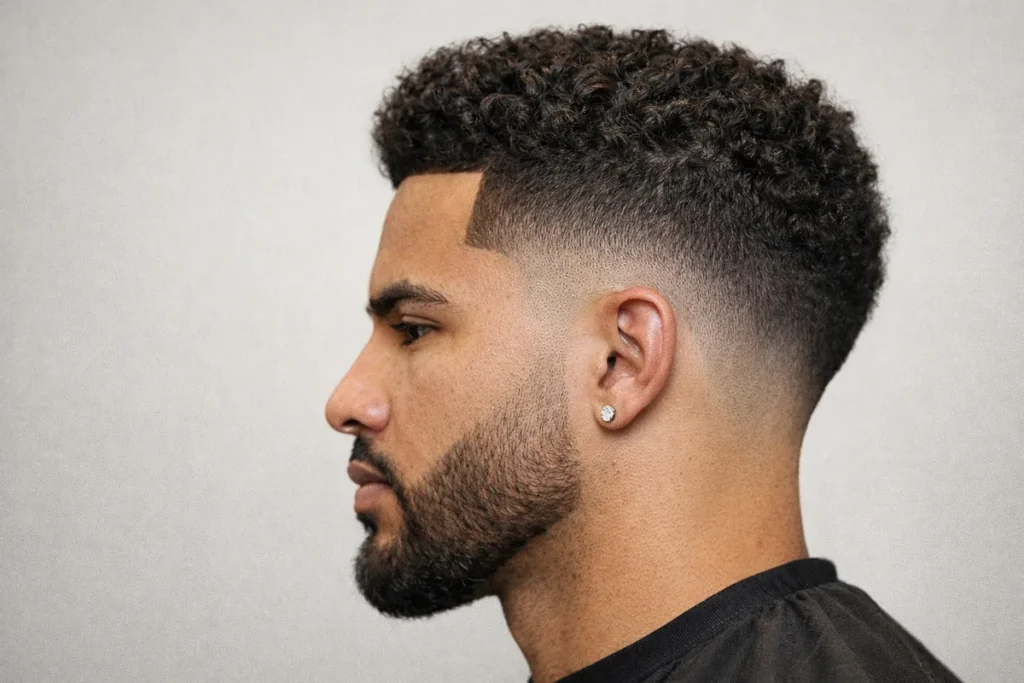
A Temple Fade is a localized fade haircut that blends hair from short to longer lengths only at the temples, rather than across the entire side or back of the head. It is often combined with a shape-up or edge-up to produce a crisp outline.
Because the fade is limited in scope, the Temple Fade style maintains a strong balance between natural volume and precise detailing.
Where the Temple Fade Is Applied
The Temple Fade is applied in specific, targeted areas:
- The temples on both sides of the head
- The sideburn transition area
- Optional blending near the upper ear
Unlike a full fade haircut, the back of the head and neckline are often left untouched or only lightly tapered.
Temple Fade Variations
Several variations of the Temple Fade exist, depending on fade height and styling preference:
- Low Temple Fade: A subtle blend that keeps most of the hair length intact
- High Temple Fade: A more pronounced fade that creates sharper contrast
- Temple Fade with Curls: Enhances natural curl definition while keeping edges clean
- Temple Fade with Line-Up: Combines fading with precise hairline shaping
Each variation maintains the defining feature of a focused temple transition rather than a full-side fade.
What Is a Taper Fade?
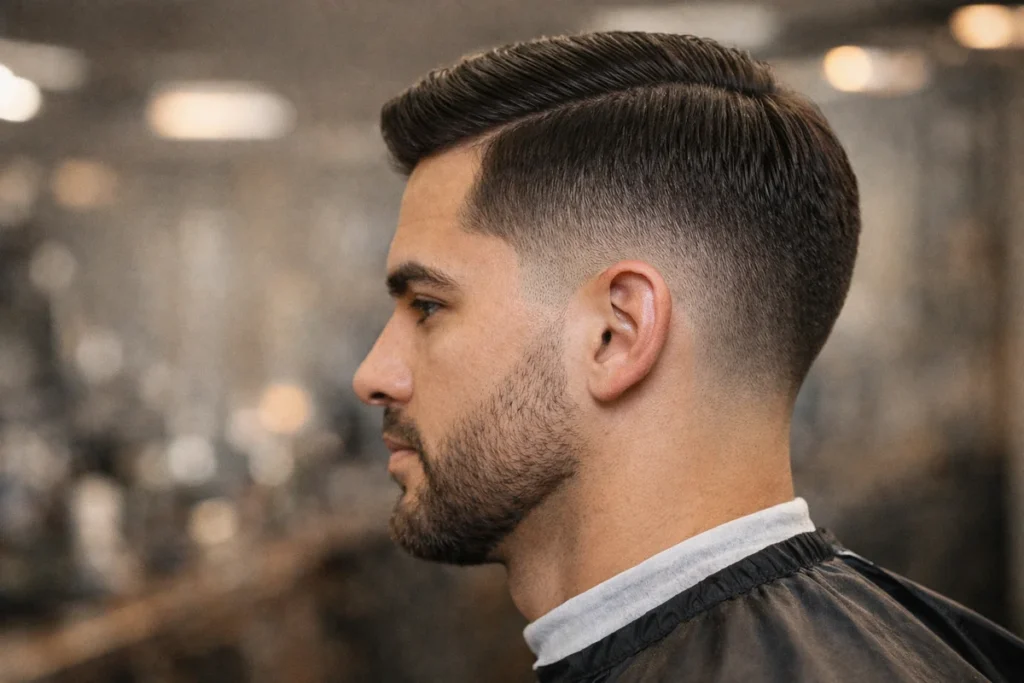
A Taper Fade is a gradual fade haircut that reduces hair length progressively toward the edges of the head, without exposing the skin. The transition is soft, controlled, and designed to grow out evenly.
This makes the Taper Fade style ideal for individuals seeking a polished look with low visual aggression.
Areas Covered in a Taper Fade
A standard Taper Fade typically includes:
- The sideburns
- The area around the ears
- The back neckline
Because of this broader coverage, the Taper Fade offers a more uniform appearance compared to a Temple Fade.
Types of Taper Fades
There are multiple variations of the Taper Fade, each defined by how low or high the taper begins:
- Classic Taper: Very subtle and conservative
- Low Taper Fade: Minimal fading near the edges
- Blowout Taper: Volume on top with clean sides
- Taper Fade vs Skin Fade: Tapers never expose bare skin
These styles are frequently recommended for office-friendly haircuts and low-maintenance grooming routines.
Temple Fade vs Taper Fade: Comparison At a Glance
A Temple Fade and a Taper Fade differ mainly in fade placement, overall visibility, and maintenance expectations. This side-by-side comparison highlights the most important distinctions to help readers quickly understand which fade haircut style suits their needs.
| Feature | Temple Fade | Taper Fade |
| Fade Coverage | Limited to the temples and sideburns | Gradual blend around the ears, sides, and neckline |
| Visual Style | Sharp, high-contrast, and edge-focused | Soft, subtle, and natural-looking |
| Hairline Definition | Strong emphasis on clean edges and line-ups | Minimal emphasis with smooth transitions |
| Maintenance Level | Requires frequent touch-ups | Lower maintenance due to even grow-out |
| Professional Appearance | More casual and style-driven | Widely accepted as a professional hairstyle |
| Best For | Modern hairstyles, textured hair, bold looks | Classic grooming, office-friendly styles |
Temple Fade vs Taper Fade: Key Differences
The key differences between a Temple Fade and a Taper Fade come down to fade coverage, visual impact, and maintenance requirements. While both fall under fade haircut styles, they deliver distinct results depending on how much hair is blended and where the transition occurs.
Fade Coverage
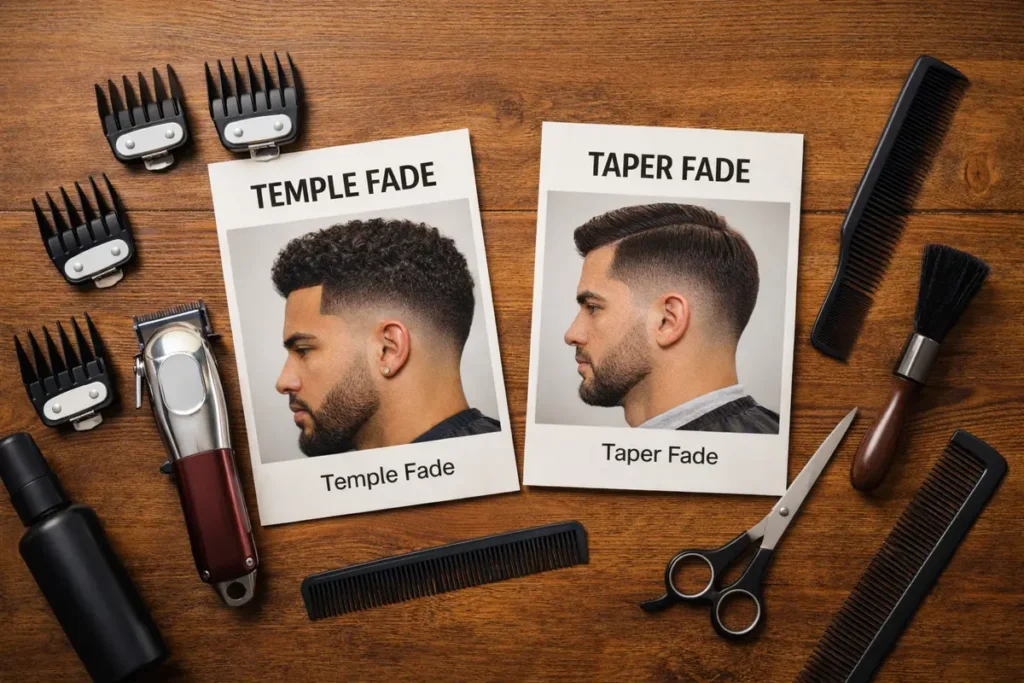
A Temple Fade applies fading only at the temples and sideburns, leaving the majority of the sides and back unchanged. This localized approach keeps the haircut structured while adding sharp definition in high-visibility areas.
In contrast, a Taper Fade gradually reduces hair length along the sides, ears, and neckline, creating a more continuous and evenly distributed blend.
Visual Impact
The Temple Fade creates a high-contrast appearance, especially when paired with a line-up or edge-up. This makes it a popular choice for modern hairstyles and trend-forward looks.
A Taper Fade, however, delivers a soft and natural finish. The gradual transition minimizes sharp lines, making the haircut appear understated and refined.
Maintenance Level
A Temple Fade typically requires frequent touch-ups, as the sharp transitions around the temples become noticeable quickly as hair grows.
A Taper Fade grows out more evenly, requiring less frequent maintenance. This makes it ideal for individuals seeking a low-maintenance haircut with long-lasting structure.
Professional vs Casual Appearance
A Temple Fade leans toward casual and style-driven aesthetics, often associated with street style and expressive grooming choices.
A Taper Fade is widely accepted as a professional hairstyle, suitable for workplaces with conservative grooming standards.
Which One Should You Choose?
Choosing between a Temple Fade and a Taper Fade depends on your personal style, hair type, and daily routine. Each fade serves a different grooming objective.
Choose a Temple Fade If:
A Temple Fade is the better option if:
- You prefer defined edges and sharp transitions
- You want a modern haircut with visual contrast
- You have curly hair or Afro-textured hair that benefits from edge definition
- You don’t mind regular barber visits
This style works especially well when paired with short hairstyles, twists, or textured tops.
Choose a Taper Fade If:
A Taper Fade is ideal if:
- You want a natural-looking haircut
- You need a professional appearance
- You prefer minimal upkeep
- You want a style that grows out smoothly
The Taper Fade haircut is commonly recommended for office settings, formal environments, and classic grooming preferences.
Try a Professional Fade Haircut Service for Modern Style
Choosing between a Temple Fade and a Taper Fade often depends on the level of sharpness and blend you prefer. Both styles require technical precision, proper guard selection, and balanced transitions. A professional fade haircut service ensures the fade placement matches your head shape and lifestyle needs. If you want structured blending with clean finishing and consistent results, consider our solid fade haircut for a sharp, durable, and well-balanced look. This service focuses on even gradients, detailed edging, and long-lasting shape control. As a result, your haircut maintains definition while growing out smoothly.
Temple Fade and Taper Fade by Hair Type
Hair texture plays a major role in determining which fade looks best. Both styles adapt differently depending on hair density and curl pattern.
Curly Hair
A Temple Fade enhances curl definition by cleaning up the edges without disrupting volume. A Taper Fade offers a softer frame that blends curls naturally into the sides.
Straight Hair
With straight hair, a Taper Fade delivers a clean and uniform look. A Temple Fade adds contrast but may appear more dramatic.
Coarse Hair
A Temple Fade works well with coarse hair by emphasizing structure and shape. A Taper Fade helps control bulk around the neckline and ears.
Wavy Hair
For wavy hair, a Taper Fade maintains flow and movement, while a Temple Fade introduces sharper visual boundaries.
Afro-Textured Hair
A Temple Fade is especially popular with Afro-textured hair, as it highlights the hairline and temples without removing density. A Taper Fade offers a more conservative alternative.
Barber Techniques Used for Temple Fades and Taper Fades
Both styles rely on precision and blending, but the execution differs based on coverage and intent.
- Guard lengths determine fade depth
- Clipper-over-comb techniques refine transitions
- Blending techniques smooth gradients
- Razor detailing sharpens edges for Temple Fades
An experienced professional barber adjusts these techniques based on head shape and hair texture.
Temple Fade vs Taper Fade: Final Verdict
The choice between a Temple Fade and a Taper Fade depends on your style preference, maintenance tolerance, and lifestyle needs. A Temple Fade delivers sharp edges, high contrast, and a modern aesthetic, making it ideal for expressive styles and textured hair. A Taper Fade offers a subtle blend, professional appearance, and low-maintenance grooming, making it suitable for nearly all settings.
Common Questions About Temple Fade vs Taper Fade
Yes, a Temple Fade pairs well with a beard fade because both emphasize clean transitions near the sideburn connection. This combination creates a cohesive look by blending the hairline into the facial hair without affecting the rest of the haircut.
A Taper Fade can be performed using scissors and comb techniques, especially for longer hairstyles. While clippers are commonly used, scissor tapering offers a softer blend and greater control over hair length transitions.
A Temple Fade can complement a receding hairline by drawing attention to clean edges rather than thinning areas. When executed carefully, it enhances facial symmetry without overexposing the hairline.
A Taper Fade typically needs refreshing every 3 to 5 weeks, depending on hair growth rate. The gradual fade structure allows the haircut to maintain its shape longer than sharper fade styles.
Yes, a Temple Fade works well with longer hairstyles by providing contrast at the front hairline while preserving length throughout the rest of the head. This approach is common in modern men’s grooming.
Yes, head shape plays a role in fade selection. A Temple Fade highlights angular features, while a Taper Fade softens contours and balances rounded head shapes.