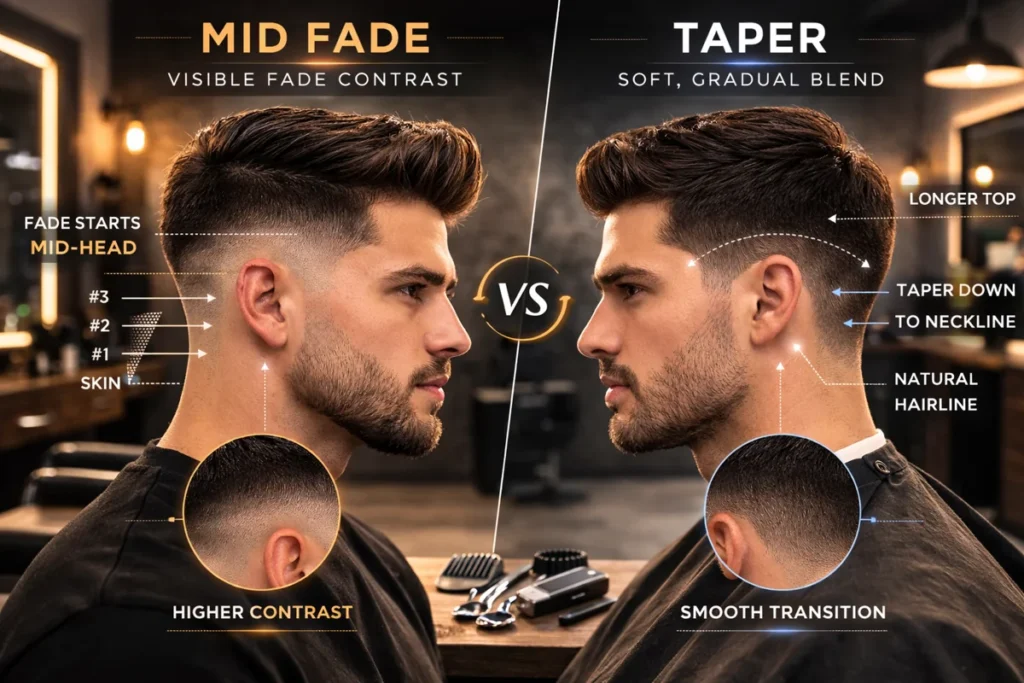
Choosing between a mid fade haircut and a taper haircut depends on how much contrast, maintenance, and style visibility you want from your haircut. A mid fade creates a sharp transition starting halfway up the sides and back, delivering a bold and modern look. A taper gradually shortens hair around the neckline and sideburns, resulting in a natural, clean, and professional finish.
What Is a Taper Haircut?
A taper haircut is defined by a gradual decrease in hair length as it moves down toward the natural hairline. Unlike fades, tapers do not expose skin and instead preserve a smooth, blended appearance. This makes the taper one of the most timeless options in classic men’s hairstyles.
The defining feature of a taper is its soft graduation, which avoids harsh lines or dramatic contrasts. Because of this, tapers are widely accepted in corporate settings, schools, and formal occasions.
How a Taper Works
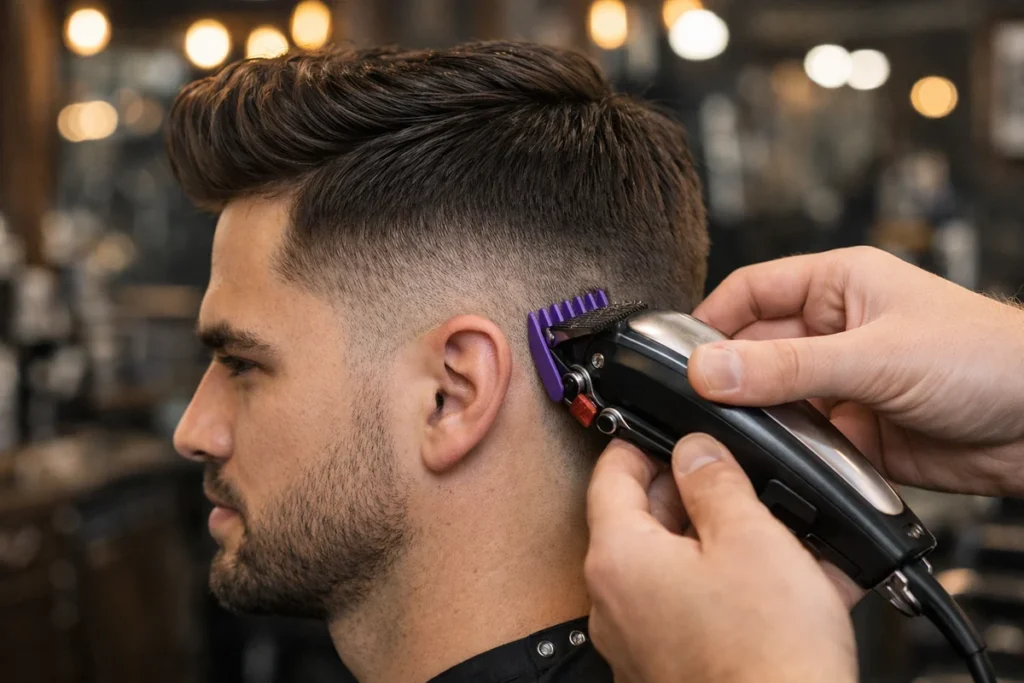
A taper focuses primarily on the neck taper, sideburn taper, and sometimes the lower sides. Barbers use clipper guard sizes and scissor-over-comb techniques to gradually shorten hair without creating abrupt transitions.
The result is a haircut that blends seamlessly into the skin without reaching a zero guard or skin fade. This technique supports a natural grow-out phase, which is why tapers are considered low-maintenance.
Tapered Areas in a Haircut
A traditional taper haircut concentrates on three main areas:
- Sideburns, which are shortened gradually
- Neckline, often finished as a natural taper, rounded taper, or blocked taper
- Lower sides, while keeping length higher up
Unlike fades, the upper sides and top length remain largely untouched, preserving structure and volume.
Types of Tapers
There are several recognized variations of the taper haircut, each offering a different level of subtlety:
- Low taper, which affects only the very bottom of the hairline
- Classic taper, commonly paired with business hairstyles
- Neck taper, focused exclusively on the nape
These variations allow flexibility without sacrificing the hallmark clean-cut appearance.
Who a Taper Is Best For
A taper haircut is ideal for individuals seeking a professional haircut, a school-appropriate style, or a low-contrast look. It works especially well for those who prefer a haircut that grows out evenly and does not require frequent reshaping.
Tapers are also well-suited for thick hair, straight hair, and wavy hair, as the gradual blending maintains balance without overexposing the scalp.
What Is a Mid Fade Haircut?
A mid fade haircut is characterized by a fade that begins approximately halfway up the sides and back of the head. Unlike tapers, mid fades intentionally create contrast by reducing hair length more aggressively.
The defining element of a mid fade is its fade line placement, which sits between the low fade and high fade, offering a balanced yet noticeable transition.
Where a Mid Fade Starts on the Head
A mid fade typically begins just above the temples and curves around the head toward the occipital bone. From that point downward, the hair transitions rapidly toward shorter lengths or even skin.
This placement makes the mid fade more visually striking than a taper, while remaining more versatile than a high fade. It draws attention to the top hairstyle, enhancing volume and shape.
How Mid Fades Are Blended
Barbers execute a mid fade using clipper fading techniques, often incorporating a fade lever, zero guard, or skin fade base. Precision blending is critical, as the fade is meant to be clearly visible yet smooth.
Because of this complexity, mid fades require a higher level of barber skill and typically demand more frequent maintenance to preserve sharpness.
Mid Fade vs Low Fade vs High Fade
A mid fade haircut sits between a low fade and a high fade in terms of placement and visual intensity. A low fade starts just above the ears and creates a subtle transition, while a high fade begins near the temples and produces a dramatic contrast.
The mid fade balances these two extremes, offering a noticeable yet controlled look. This balance is why mid fades are commonly chosen for modern men’s hairstyles that need to look sharp without appearing overly aggressive.
Taper vs Mid Fade : Side-by-Side Comparison
The difference between a taper haircut and a mid fade haircut becomes most clear when viewed side by side. While both styles clean up the sides and back, they differ in hair length transition, visual intensity, maintenance demands, and overall style perception. The table below breaks down these differences in a clear, scannable format optimized for featured snippets and comparison queries.
| Comparison Factor | Taper Haircut | Mid Fade Haircut |
| Hair Length Transition | Gradual and subtle reduction focused on the neckline and sideburns | Noticeable gradient starting midway up the sides and back |
| Blend Style | Soft, natural hair blending with minimal contrast | Sharp, defined fade blending with visible transition |
| Visual Impact | Understated and clean appearance | Bold, modern, and eye-catching look |
| Sharpness Level | Low contrast with a soft finish | High contrast with a clean fade line |
| Maintenance Frequency | Low maintenance with longer intervals between barber visits | Higher maintenance requiring frequent touch-ups |
| Grow-Out Behavior | Even and natural hair regrowth | Fade line softens quickly during regrowth |
| Professional Suitability | Highly suitable for corporate environments and formal settings | More common in trend-driven grooming and casual settings |
| Styling Flexibility | Pairs well with classic and conservative top hairstyles | Enhances textured and modern top styles |
| Overall Style Impression | Timeless, conservative, and refined | Contemporary, structured, and fashion-forward |
Which Looks More Natural: Taper or Mid Fade?
A taper haircut is generally considered more natural because it follows the natural hairline and avoids harsh contrasts. The blending mimics natural hair growth patterns.
A mid fade is intentionally stylized and therefore less natural-looking. Its appeal lies in precision and contrast rather than subtlety.
Clean vs Subtle Transitions
Tapers rely on subtle transitions that are barely noticeable. This makes them ideal for individuals who want a clean haircut without drawing attention.
Mid fades prioritize clean lines and visible transitions, making the haircut a focal point of the overall appearance.
Workplace and Dress Code Considerations
For strict corporate environments, a taper haircut is often the safer choice due to its conservative appearance. It blends seamlessly with traditional grooming expectations.
A mid fade haircut is better suited for flexible workplaces, creative industries, or individuals comfortable with a more expressive style.
Experience the Best Mid Fade and Taper Haircut Services
Choosing between a mid fade and a taper requires technical accuracy and controlled blending. Both styles demand smooth transitions, balanced proportions, and clean finishing around the neckline and temples. A well-executed fade haircut service ensures the fade placement matches your head shape, hair texture, and lifestyle needs. For clean gradients and detailed edge work, book a precision fade haircut service that focuses on symmetry and long-lasting sharpness. Experienced barbers manage contrast carefully and refine every section. As a result, your haircut looks structured, polished, and easy to maintain.
Which Is Easier to Maintain?
When comparing ease of maintenance, the taper haircut has a clear advantage. Its gradual design allows for longer intervals between haircuts.
The mid fade haircut, while visually striking, demands consistent upkeep to maintain its sharp contrast and defined shape.
Barber Visit Frequency
Most tapers can last several weeks without losing structure. Mid fades typically require touch-ups every few weeks to keep the fade clean.
Grow-Out Timeline
A taper grows out evenly and predictably. A mid fade can appear uneven during regrowth if not maintained regularly.
Styling Product Needs
Tapers often require minimal styling products. Mid fades frequently rely on pomade, hair clay, or matte finish products to complement the structured look on top.
Taper vs Mid Fade by Hair Type
Choosing between a taper haircut and a mid fade haircut depends heavily on hair type. Each style interacts differently with hair texture, density, and natural growth patterns.
Straight Hair
For straight hair, a mid fade enhances structure by creating contrast against the smooth texture. It prevents the sides from appearing flat and highlights the top hairstyle.
A taper works well for straight hair when a subtle, professional finish is preferred. The natural blending complements clean lines without overexposing the scalp.
Wavy Hair
A taper haircut is especially effective for wavy hair because it preserves movement and avoids excessive bulk removal. The gradual transition maintains balance and shape.
A mid fade can still work with wavy hair, but requires precise blending to avoid an uneven appearance during regrowth.
Curly Hair
For curly hair, a mid fade haircut is often preferred to control volume on the sides while allowing curls to stand out on top. The contrast creates a defined silhouette.
A taper offers a softer alternative for those who want to keep curls more uniform and natural-looking.
Thick vs Thin Hair
Individuals with thick hair benefit from mid fades because the fade removes weight and enhances shape. Tapers may feel too heavy on the sides if not carefully executed.
For thin hair, a taper helps maintain density by avoiding excessive skin exposure. Mid fades can make thinning areas more noticeable if not styled properly.
Taper vs Mid Fade by Face Shape
Face shape plays a crucial role in determining whether a taper or mid fade will be most flattering.
Round Face
A mid fade haircut helps elongate a round face by adding height and reducing side volume. This creates a more balanced appearance.
A taper can work but may emphasize roundness if not paired with added volume on top.
Oval Face
An oval face shape is compatible with both tapers and mid fades. The choice depends more on style preference and lifestyle than facial proportions.
Square Face
For a square face, a mid fade accentuates strong jawlines and angular features. The sharp contrast complements structured facial geometry.
A taper softens the look slightly, offering a more conservative alternative.
Long Face
A taper haircut is generally better for a long face, as it avoids excessive height and maintains proportional balance. Mid fades may exaggerate facial length if paired with tall styles.
How to Ask Your Barber for a Taper or Mid Fade
Clear communication with your barber is essential to achieving the desired result.
What to Say for a Taper
Ask for a taper haircut with a natural neck taper and blended sideburns. Specify how conservative or noticeable you want the taper to be.
Mention whether you prefer a low taper or a classic taper to avoid confusion.
What to Say for a Mid Fade
Request a mid fade haircut starting halfway up the sides, and clarify whether you want a skin fade or a guarded finish. Indicate how sharp you want the fade line.
Bringing a reference photo helps ensure alignment on fade placement.
Common Barber Terms to Use
Using correct barber terminology improves accuracy. Useful phrases include clipper guard size, blend, fade lever, and edge-up.
Mistakes to Avoid
Avoid vague requests like “short on the sides.” Always specify fade height, taper type, and desired top length.
Final Verdict: Taper vs Mid Fade
The choice between a taper haircut and a mid fade haircut comes down to personal style, maintenance tolerance, and environmental expectations. A taper offers a timeless, low-maintenance, and professional look.
A mid fade delivers sharper contrast, modern appeal, and stronger visual impact. Understanding these differences ensures you select a haircut that fits both your appearance and lifestyle.
Frequently Asked Questions
A mid fade haircut may expose more scalp, which can make oil buildup more noticeable and lead to more frequent washing. A taper haircut keeps more hair coverage, helping distribute natural oils evenly across the scalp.
A taper haircut tends to work better with headwear because it avoids sharp fade lines that can become flattened or misshapen. A mid fade may lose its clean appearance more quickly when worn under tight hats or helmets.
A taper haircut is generally more forgiving for receding hairlines because it does not draw attention to contrast areas. A mid fade haircut can sometimes emphasize hairline recession due to its sharp transitions.
In warmer climates, a mid fade offers improved airflow and cooling due to reduced hair density. In cooler environments, a taper haircut provides more insulation and comfort.
A mid fade haircut can create dramatic contrast with hair coloring or highlights, making color transitions more visible. A taper haircut produces a smoother blend, resulting in a more subtle color gradient.
A mid fade often photographs better in high-contrast lighting because its sharp lines create definition. A taper haircut performs better in professional headshots where a natural and balanced appearance is preferred.